
Best Baby Monitors (2026): Video, Audio, and No-Wi-Fi Picks
The best baby monitor for most families in 2026 is a no-Wi-Fi video monitor with a real parent screen, and the one I'd point a friend to first is the Infant Optics DXR-8 PRO. It doesn't need an app, an account, a router, or a monthly fee. You plug in the camera, turn on the screen, and it works at 2 a.m. when the internet is down and your phone is at 4%.
That's not a knock on smart monitors. If you want to check the nursery from work, or you actually care about sleep graphs, a Wi-Fi camera like the Nanit Pro does things a closed system can't. You just pay for it twice: once at checkout and again for the features behind a subscription.
So this guide sorts monitors by the question that actually matters at 2 a.m.: what happens when something breaks? Six picks from about $37 to about $290, video and audio-only, with prices that update daily.
Best Baby Monitors at a Glance
| Monitor | Connection | Parent Screen | Subscription | Price | Best For |
|---|---|---|---|---|---|
| Infant Optics DXR-8 PRO | No Wi-Fi (FHSS) | 5 in, HD | None | $199.99 | Best overall |
| eufy Baby Monitor E21 | Local plus Wi-Fi | 5 in, 720p | None advertised | $249.99 | Best hybrid |
| Nanit Pro (Wall Mount) | Wi-Fi only | Your phone | Optional, for sleep data | $289.99 | Best smart monitor |
| HelloBaby HB6550 | No Wi-Fi (FHSS) | 5 in | None | $63.17 | Best big screen on a budget |
| VTech VM819 | No Wi-Fi (FHSS) | 2.8 in | None | $44.96 | Best under $50 |
| VTech DM221 | No Wi-Fi (DECT 6.0) | None (audio) | None | $36.95 | Best audio-only |
Prices as of Oct 30, 2026, 11:56 AM UTC. Product prices and availability are accurate as of the date/time indicated and are subject to change. Any price and availability information displayed on Amazon.com at the time of purchase will apply to the purchase of this product.
Do You Even Need a Video Baby Monitor?
Not always. If your place is small enough that you'd hear the baby through the wall anyway, an audio monitor covers the job for under $40. Video earns its money in three situations:
- You're trying to decide whether to go in. Fussing and real crying sound alike through a speaker. On a screen you can see whether the kid is resettling or standing up and shaking the crib rails like a tiny inmate.
- The nursery is far away. Two floors, a basement office, or a backyard with a grill going.
- Two parents, two shifts. Whoever is off duty can check the screen without getting up and without waking the other person.
What no monitor does is keep a baby safe. That's the crib setup's job. The American Academy of Pediatrics is blunt about it: there's no evidence that consumer heart rate or oxygen monitors reduce SIDS risk, and they shouldn't replace safe sleep basics (back to sleep, firm flat mattress, nothing else in the crib). A monitor is a window into the room. It's not a lifeguard.
Wi-Fi vs No-Wi-Fi Baby Monitors: The Short Answer
This is the decision that sorts everything else, so here's the plain version.
| Question | No-Wi-Fi (closed system) | Wi-Fi (app-based) | Hybrid |
|---|---|---|---|
| Works when the internet is down? | Yes | No | Yes, on the parent unit |
| Check from work or a date night? | No | Yes | Yes |
| Video leaves your house? | No | Yes, through the company's servers | Only when you use the app |
| Account and app required? | No | Yes | Only for remote viewing |
| Monthly fees? | Never | Often, for history and analytics | Depends on brand |
| Range limit? | Yes, often advertised as about 1,000 ft line of sight | Anywhere with signal | Both |
Closed-system monitors talk directly from camera to screen using a frequency-hopping radio (FHSS on video units, DECT on audio). Nobody can log into them from the internet because there's nothing to log into. That's the whole privacy pitch, and it's a good one. The trade is that you can't see the baby from anywhere outside the house.
Wi-Fi cameras are only as reliable as your router, your phone, and the company's servers. Owner complaints about app monitors almost always come back to one of those three: a lagging stream, a missed notification, or an outage on the company's side. If you go Wi-Fi, use a strong unique password and turn on two-factor sign-in the day you set it up.
The 6 Best Baby Monitors in 2026

1. Infant Optics DXR-8 PRO: Best Overall
- 5-inch HD parent screen, no Wi-Fi, no app
- Encrypted FHSS link from camera to monitor
- Remote pan, tilt, and zoom
- Interchangeable lenses: standard and zoom included, wide-angle sold separately
- Active noise reduction filters fans, air purifiers, and AC hum
- User-replaceable battery
The DXR-8 line has been the default "just get this one" answer in parent forums for years, and the PRO version fixed the two things people used to complain about. The noise reduction means a box fan or white noise machine doesn't turn the speaker into a wall of static. And the battery is swappable, which matters more than it sounds: the most common way older monitors die is a battery that won't hold a charge after a year, and here that's a part, not a new monitor.
Real trade-offs from long-term reviews: battery life at full brightness runs around 6 hours in one detailed review, so plan on keeping it on the charger overnight or using the screen-off audio mode. The wide-angle lens is extra, and if your camera sits across a big room you'll probably want it.
- Nothing to hack, no account, no fees, ever
- Noise reduction is useful if you run white noise
- Swappable lens and battery extend its life
- No remote viewing outside the house
- Short battery life with the screen on full
- Wide-angle lens costs extra
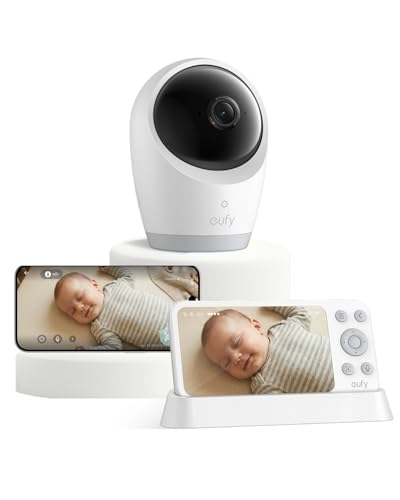
2. eufy Baby Monitor E21: Best Hybrid (No Subscription)
- 4K camera with 330 degree pan, 60 degree tilt, 8x zoom
- 5-inch 720p parent screen that works locally without Wi-Fi
- Optional app for remote viewing, shareable with up to 5 family members
- 24/7 recording in the app, no subscription fee advertised
- 5,000mAh battery in the camera, so it keeps running in a power outage
- Noise reduction rated at 20 dB
This is the one for the parent who wants both: a dedicated screen on the nightstand that works with the router unplugged, plus the option to peek from the office. eufy's whole pitch is that you don't pay monthly for recording, which is exactly where most app monitors make their money.
The battery in the camera is the sneaky useful feature. It means you can carry the camera to a grandparent's house or a hotel and it keeps running if the power blinks. On the flip side, eufy's earlier SpaceView monitors drew owner complaints about batteries fading and units shutting down at random, so register it and keep the receipt. And remember that the moment you turn on the app, your video is going through eufy's cloud, which is a different privacy deal than a closed system.
- Local screen plus remote app in one box
- No monthly fee for recording, per the listing
- Camera battery covers outages and travel
- Most expensive non-smart pick here
- App mode means trusting eufy's cloud
- Older eufy models had battery complaints
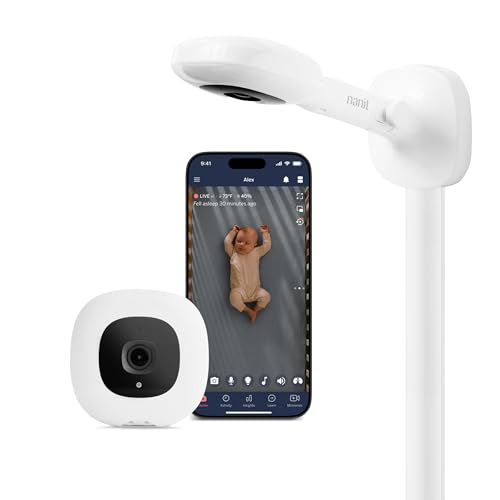
3. Nanit Pro (Wall Mount): Best Smart Monitor
- 1080p overhead camera, streams to your phone
- Live video, two-way audio, motion and sound alerts, temperature and humidity work without a paid plan
- Sleep tracking, trends, and saved clips need a Nanit Insights subscription
- Works with Alexa and Google Home displays
- Wi-Fi only (2.4GHz), no battery backup
The Nanit is the monitor for the dad who wants data. Mounted over the crib, it figures out when the baby fell asleep, how many times they woke, and how long you spent in the room. When you're arguing at 3 a.m. about whether the new bedtime is helping, a graph settles it faster than either of your memories.
The catch is everything around that. There's no parent unit, so your phone is the monitor. The overhead wall mount is what makes the sleep tracking work, and plenty of rooms (and renters) can't do it. Reviewers and owners report stream lag on crowded home networks, and when Nanit's servers have had outages, the camera went dark with them. The free tier is a decent Wi-Fi camera; the sleep features are a paid plan after the trial, so check Nanit's current pricing before you buy.
- Best-in-class sleep tracking and trends
- Sharp 1080p overhead view
- Easy to share with a partner or grandparent
- Phone is the only screen
- Sleep features cost extra every year
- Useless during an internet or power outage

4. HelloBaby HB6550: Best Big Screen on a Budget
- 5-inch parent screen, no Wi-Fi (encrypted 2.4GHz FHSS)
- Remote pan 355 degrees and tilt 120 degrees, 2x zoom
- Advertised up to 30 hours of battery with the screen-saving audio mode
- Range advertised at 1,000 ft
- Expands to 4 cameras
The HB6550 gets you the same screen size as the DXR-8 PRO and real pan and tilt for roughly a third of the price. That's the whole reason it shows up on so many registries. It's also the monitor I'd pack for trips, which is why it's in our travel baby monitor guide for hotels and Airbnbs too: no Wi-Fi password to beg from the front desk.
What you give up is image sharpness and polish. The picture is softer than the premium units, and the audio has no fancy noise filtering, so a loud fan in the nursery will come through. For the money, those are fair trades.
- 5-inch screen and pan/tilt for the price of a small screen elsewhere
- Long battery life in audio mode
- No app, no account, travel-friendly
- Softer image than premium picks
- No noise reduction
- No remote viewing

5. VTech VM819: Best Under $50
- 2.8-inch screen, no Wi-Fi (encrypted 2.4GHz FHSS)
- Up to 19 hours of video or 29 hours of audio-only on one charge
- Sound-activated screen stays dark until the baby makes noise
- Range advertised at 1,000 ft
- Fixed camera, 2x digital zoom, no pan or tilt
The VM819 is small and plain and it runs forever. That 19-hour battery claim held up well in one long-form review (around 17 and a half hours), which means it can live in your pocket all evening and still make it through the night. The sound-activated screen is the feature I'd want most: the screen stays black until the baby makes noise, so it isn't lighting up your bedroom at 1 a.m.
The screen is tiny, though. At 2.8 inches you'll see the baby, but you won't see much detail, and there's no pan, so aim the camera carefully. If you want pan and tilt from VTech, the step-up models cost more.
- Cheapest video pick on this list
- Excellent battery life
- Screen stays off until there's sound
- Small 2.8-inch screen
- No pan or tilt
- Basic picture quality

6. VTech DM221: Best Audio-Only Monitor
- DECT 6.0 digital audio, no Wi-Fi
- Range up to 1,000 ft
- 5-light sound level indicator, so you can "see" noise with the volume down
- Vibrating alert and belt clip
- Talk-back intercom and night light on the baby unit
Audio monitors are underrated, and this is the one people keep buying. DECT means clear sound with very little interference from your Wi-Fi or cordless gadgets. The vibrating alert is the dad feature here: clip it to your belt while you mow the lawn or take a work call, and it buzzes when the baby cries.
It's also a good second monitor even if you buy a video one. Batteries die, screens crack, and a $37 audio unit in the kitchen drawer means you're never without one. The obvious limit is that you can't tell real crying from complaining without walking in.
- Cheap, simple, and reliable
- Vibrate mode for loud places
- Clear DECT audio with little static
- No video
- Night light is basic
- Parent unit is a bit bulky on a belt
How to Choose a Baby Monitor (Without Overthinking It)
Answer these four questions in order and the choice mostly makes itself.
1. Will you ever need to check from outside the house?
If no, buy a closed system and stop reading reviews of smart cameras. If yes, it's a hybrid (eufy E21) or a Wi-Fi camera (Nanit).
2. How big is the house?
One-floor apartment: audio-only is fine. Two floors or a detached garage: video, and test the range before you lose the box.
3. Do you run white noise or a fan in the nursery?
Then noise reduction is worth paying for, or the speaker will hiss all night. The DXR-8 PRO and eufy E21 both filter it. If you haven't picked a sound machine yet, our white noise machine guide covers the ones that pair well with a monitor.
4. Are you willing to pay every year?
Add up three years of any subscription before you compare sticker prices. A $290 camera with an annual plan can cost more than double a $200 closed system by the time your kid is in preschool.
Where to Put a Baby Monitor Camera
This part is a safety issue, not a preference. After two infant strangulation deaths linked to monitor cords, the U.S. Consumer Product Safety Commission told parents to never place corded cameras within three feet of a crib and to keep cords out of a child's reach.
- Three feet minimum from the crib for the camera and every inch of its cord. Wall mounts high above the crib are fine as long as the cord is secured along the wall, out of reach.
- Never on the crib rail. Clip-on crib mounts exist; skip them unless the manufacturer's instructions and cord management keep everything out of reach.
- Aim at the whole mattress, not just the middle. Babies migrate. Toddlers migrate faster.
- Recheck at every milestone. The day your kid can pull to stand, their reach doubles. Do a cord sweep that week.
And once the camera is up, keep the rest of the room boring too. A dim warm night light helps the night vision on most cameras without lighting up the crib like a parking lot.
Frequently Asked Questions
Are non-Wi-Fi baby monitors safer?
For privacy, yes. A no-Wi-Fi monitor sends video straight from the camera to the parent unit over an encrypted radio link, so there's no account or internet connection for anyone to break into. Wi-Fi monitors can be secured well, but they depend on your password, your router, and the company's servers.
Do I need a baby monitor with a subscription?
No. Live video, sound alerts, and two-way talk are free on every monitor in this guide. Subscriptions usually pay for sleep tracking, analytics, and saved video history. If you won't look at sleep graphs, skip the plan.
How far should a baby monitor be from the crib?
At least three feet, including the cord. The CPSC set that distance after strangulation deaths linked to monitor cords. Mounting the camera high on a wall with the cord secured is the cleanest setup.
Can a baby monitor prevent SIDS?
No. The American Academy of Pediatrics says there's no evidence that home or wearable monitors reduce SIDS risk. Safe sleep practices do: baby on their back, on a firm flat surface, with nothing else in the crib.
When can you stop using a baby monitor?
There's no set age. Many families phase it out somewhere between 2 and 4 years old, once the child can reliably get out of bed and come find a parent, or when the house is small enough to hear them without it.
The Short Version
- Best baby monitor overall: Infant Optics DXR-8 PRO, a 5-inch no-Wi-Fi monitor with noise reduction, swappable lenses, and no fees.
- Best hybrid: eufy Baby Monitor E21, which works locally without Wi-Fi and adds remote app viewing with no advertised subscription.
- Best smart monitor: Nanit Pro, a 1080p overhead camera whose sleep tracking needs a paid Insights plan.
- Best budget video: HelloBaby HB6550 (5-inch screen, pan and tilt) or VTech VM819 (up to 19 hours of video battery).
- Best audio-only: VTech DM221, DECT audio with 1,000 ft range and a vibrating alert.
- Keep every monitor camera and cord at least 3 feet from the crib, per the CPSC.
Sources and Further Reading
The Bottom Line on the Best Baby Monitor
For most dads, the best baby monitor is the one that still works when everything else in the house doesn't, and that's the Infant Optics DXR-8 PRO. Want to check in from work without paying monthly? Get the eufy E21. Want sleep data and have rock-solid Wi-Fi? The Nanit Pro is the smart pick. On a budget, the HelloBaby HB6550 is the value play, and a $37 VTech DM221 makes a great backup for any of them. Whatever you buy, mount it three feet from the crib and then go to sleep. That's what it's for.
Affiliate + Accuracy Disclosure
Product specs, pricing, and availability can change. Please verify current details on Amazon before buying. Recommendations are based on published specs, owner feedback, and practical dad-focused use cases.